
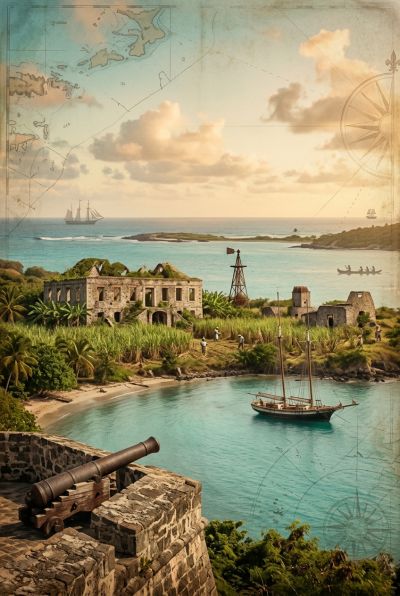
Long before tourists snapped photos of pastel facades, the Virgin Islands were a crossroads of peoples, powers, and painful transformations. Harry Meyer’s single‑volume history pulls those layers apart, showing how the archipelago’s story is woven from indigenous roots, colonial rivalries, and the enduring fight for freedom.
What the book is about
The book opens with the islands’ earliest inhabitants — the Ciboney, Taíno, and Kalinago — and follows their displacement after Columbus’s 1493 landing, when he christened the chain Santa Úrsula y las Once Mil Vírgenes. Meyer then traces the scramble among Spanish, Danish, British, and other powers, the rise of sugar plantations, and the brutal transatlantic slave trade that fueled them. Chapters detail enslaved Africans’ resistance, from the 1733 St. John insurrection to the Fireburn revolt, and the differing paths to emancipation in the British and Danish territories. Post‑emancipation struggles for land, labor, and autonomy lead into the twentieth‑century rise of tourism and finance, while the final sections explore the living culture — Quelbe, Fungi, Anansi tales — and the environmental pressures of hurricanes, coral bleaching, and military contamination. The work is aimed at readers who want a comprehensive, single‑volume narrative that connects past struggles to present‑day realities.
From First Peoples to Colonial Clash
Meyer begins by grounding the islands in deep time, noting that "[t]he first human presence in the islands dates back to at least 1500 BC, and possibly as early as 2200 BC" with successive waves of Ciboney, Igneri/Taíno, and later Kalinago peoples. He describes how Columbus’s 1493 fleet, struck by the multitude of islands, named them Santa Úrsula y las Once Mil Vírgenes, a reference that was later shortened to Las Vírgenes, and how he personally dubbed Virgin Gorda "the Fat Virgin." The narrative then moves to the sixteenth‑ and seventeenth‑century power vacuum left by Spain’s neglect, which attracted English privateers like Sir Francis Drake, Dutch traders such as Joost van Dyk, and the notorious buccaneers who used hidden coves for careening and refuge. Meyer highlights the English seizure of Tortola in 1672, the Dutch attempts to hold on, and the eventual consolidation of British control over Tortola, Virgin Gorda, and Anegada, while the Danes, through the West India Company, established settlements on St. Thomas in 1672 and St. John in 1694, laying the groundwork for the colonial divisions that still shape the archipelago today.
Sugar, Slavery, and Resistance
With sugar established as the islands’ economic engine, Meyer shows how the plantation system depended on a relentless supply of enslaved African labor, describing the transatlantic trade as "the engine that drove the plantation economy" and noting that St. Thomas became a major regional slave market. He details the brutal realities of the Middle Passage, the seasoning process, and the hierarchical slave village life, then turns to acts of defiance. The 1733 St. John Slave Insurrection, led by Akwamu nobles, saw rebels seize the island for six months; Meyer writes that "[t]he sound of the cannon unleashed a coordinated wave of violence" as the uprising began. Though ultimately crushed, the revolt echoed in later uprisings such as the 1848 Fireburn on St. Croix, where enslaved laborers demanded freedom and burned plantations. Alongside these violent struggles, Meyer highlights the Moravian missionaries, who preached in the local Dutch‑based creole Negerhollands and established schools that inadvertently nurtured literacy and a sense of self‑worth among the enslaved, even as the mission itself owned slaves—a paradox he does not shy away from.
Emancipation and Its Aftermath
Emancipation arrived differently across the territories. In the British Virgin Islands, the Slavery Abolition Act of 1833 set August 1, 1834 as the date of legal freedom, though Meyer notes that the ensuing apprenticeship system forced former slaves to continue unpaid labor for up to six years, a situation he describes as "slavery under another name." In the Danish West Indies, freedom was seized from below: on July 3, 1848, Governor Peter von Scholten declared, "All unfree in the Danish West India Islands are from today free," after a mass march led by John Gottlieb ("General Buddhoe") threatened to burn Frederiksted. Meyer then explores the post‑emancipation scramble for land, quoting him that "[t]he acquisition of land became the central drama of the post-emancipation era," as freed people pooled wages to buy small plots, squatted on Crown land, and built independent villages, while planters responded with laws like the 1849 Labor Act that bound workers to estates through exploitative contracts. The result, he argues, was a prolonged tug‑over the meaning of freedom that shaped labor relations, family life, and the emergence of peasant societies in both the British and Danish islands.
Tourism, Finance, and Modern Struggles
Meyer carries the story into the twentieth century, where the decline of sugar gave way to new economic pillars. In the U.S. Virgin Islands, he notes that tourism now accounts for an estimated 60 % of GDP and a similar share of employment, with Charlotte Amalie’s harbor ranking among the world’s busiest cruise ports; he observes that "[t]he islands’ fortunes were now inextricably tied to the health of the U.S. economy, the price of jet fuel, and even the weather," making the territory vulnerable to recessions and hurricane seasons. Contrasting this, the British Virgin Islands pursued a dual‑model of upscale yacht‑charter tourism and international financial services, leveraging their status as a British Overseas Territory to attract high‑spending visitors and offshore companies. Meanwhile, the Spanish Virgin Islands of Vieques and Culebra emerged from decades of U.S. Navy bombardment to develop small‑scale eco‑tourism centered on attractions such as Vieques’s bioluminescent bay and Culebra’s Flamenco Beach, though Meyer points out that unexploded ordnance and contaminated soils from the military’s sixty‑year presence continue to hinder development and pose health concerns. Across all three territories, he warns that climate change, rising seas, and more intense storms threaten the very infrastructure that sustains these modern economies.
Culture, Memory, and the Environment
Beyond economics and politics, Meyer devotes considerable space to the living culture that has endured despite centuries of upheaval. He writes that "[t]he soul of the Virgin Islands finds its rhythm in the distinctive sounds of its native music," highlighting Quelbe (scratch‑band) in the U.S. islands and Fungi in the British islands, both born on plantations and still heard at festivals and street parties. The oral tradition features the trickster spider Anansi and the malevolent jumbies, tales that Meyer notes were carried across the Atlantic by enslaved Africans and adapted to island life. Culinary staples such as fish and fungi, callaloo, and johnnycakes reflect West African roots blended with European ingredients, while annual celebrations — Carnival in St. Thomas, the Crucian Christmas Festival in St. Croix, and the Emancipation Festival in the BVI — turn history into vibrant, communal memory. Architecturally, pastel‑colored Danish façades in Christiansted and Charlotte Amalie stand beside wooden homes built by freed communities, each a tangible testament to a blended heritage. On the environmental side, Meyer traces how the sugar era’s deforestation left "[t]he legacy of this agricultural past ... written in the impoverished soil of many hillsides and the layers of sediment that still cloud the coastal waters after a heavy rain," and how modern threats — sediment runoff, overfishing, coral bleaching, the stony coral tissue loss disease, and invasive lionfish — jeopardize reefs that protect shores and sustain fisheries. He concludes that conservation efforts, from marine protected areas to community‑run coral nurseries, are now essential not just for beauty but for the islands’ survival in a warming world.
Who should read this
This book will reward anyone who wants a thorough, single‑volume account of the Virgin Islands that moves beyond resort brochures. Students of Caribbean history will appreciate the detailed chapters on indigenous peoples, colonial rivalries, and the transatlantic slave trade, while travelers seeking a deeper understanding of the places they visit will gain insight into how tourism, finance, and environmental pressures shape daily life. Readers drawn to stories of survival, resistance, and cultural fusion — whether through the 1733 St. John insurrection, the Moravian missionaries’ schools, or the vibrant Quelbe and Fungi traditions — will find plenty to engage them. Those looking for a light, anecdotal romp or a guidebook‑style overview may find the density of detail overwhelming; Meyer’s work is best suited for readers who value depth, context, and a willingness to confront the uncomfortable truths that underlie the islands’ beauty.
Read “The Virgin Islands” on MixCache.com →
Please log in or create an account to leave a comment.
No comments yet. Be the first to say something.